









Neodymium (Rare Earth) Magnetic/Physical Properties
Neodymium Magnets are the strongest of all permanent magnets with a strong magnetic field and highly resistant to demagneising when influenced by another magnetic field. Due to their strength they should be handled with care as they can be attract to another magnet or a ferrous surface with a strong force.
These magnets are also inherently fragile and allowing them to attract to a surface with force will cause them to shatter and splinter. Our Pot and Holding range however is designed with a steel surround that not only protects the magnet from physical damage but also redirects the magnetic field making a stronger single sided magnet allowing for a strong holding solution.
As they are the strongest magnet available on the market these have quickly become the most commonly used magnet in items from mobile phones to magnetic separation equipment used in food processing plants to not only protect machinery but also to ensure a ferrous free product.
Magnets Australia stock a massive range of Neodymium Magnets in all sizes and shapes to cater to any need, however should you require a size that we don’t stock, we are able to custom make a magnet on request.
Our standard range of Neodymium Magnets have a heat tolerance of up to 80°C, subjecting to temperatures over this will cause the magnet to loose a portion of its magnetism as it looses its magnetic properties and reverts back to its previous state being iron. We have a number of higher grades that allow for a higher heat tolerance up to a maximum of 230°C, use our advanced find a magnet system to filter our high temperature range. If you need a magnet with a higher heat tolerance we would recommend the use of Samarium Magnets that can withstand up to 250°C.
Many of our Neodymium Magnets are nickle coated for protection however if these are placed into an area of high moisture or a chemical environment they will corrode and fail over time making our standard range not suitable for outdoor environments as they lack a waterproof protective layer.
Our Fishing Magnet range is the only exception for this as they are designed to be be used short term in bodies of water, these magnets are a part of our Pot and Holding range and as such uses a steel surround to protect the magnet from physical impacts. When finished these should be thoroughly dried for storage.
If you are wanting a waterproof magnet we have several plastic and rubber encased magnets that are suitable for an outdoor environment, please note that due to the plastic casing there is now an ‘airgap’ between the magnet and the surface it is attracting to which has resulted in a slightly reduced magnetic holding force.
For full technical specs regarding our Neodymium Magnet, please download our Neodymium MSDS sheet.
Magnet Grades
| Magnet Type Suffix (Neodymium) |
Rev Temp Coefficient of Induction (Br), a, %/°C (20-100°C) |
Rev Temp Coefficient of Coercivity (Hci), b, %/°C (20-100°C) |
Maximum Working Temperature (Based On High Working Point) |
|---|---|---|---|
| (No Suffix – Standard Neodymium) | -0.12 | -0.6 | 80°C = 176°F * |
| M | -0.12 | -0.58 | 100°C = 212°F |
| H | -0.11 | -0.58 | 120°C = 248°F |
| SH | -0.1 | -0.55 | 150°C = 302°F |
| UH | -0.09 | -0.52 | 180°C = 356°F |
| EH | -0.085 | -0.5 | 200°C = 392°F |
| VH / AH | -0.08 | -0.45 | 230°C = 446°F |
*60°C for N50 and N52 Grades
Elevated temperatures can affect a magnet’s performance in three main ways.
Reversible loss occurs when magnetic output decreases as temperature rises but fully returns once the magnet cools back to ambient. This behaviour is described by the temperature coefficients. For example, a 20°C rise above ambient can reduce the magnetic output of an N42 magnet by about 2.4% (20 × 0.12%), but this loss is fully recovered when the temperature drops again.
Irreversible but recoverable loss happens when magnetic output decreases and does not return after cooling. This typically occurs when high temperatures push the intrinsic operating point beyond the knee of the intrinsic demagnetisation curve, causing partial demagnetisation. Although the loss can be reversed by remagnetising the Neodymium magnet, in practical applications the output is effectively lost, as remagnetisation is rarely performed in service. Even if remagnetised, the magnet will demagnetise again if reused in the same high-temperature application unless the magnetic circuit is improved.
After cooling, a magnet that has suffered this type of loss will retain its original intrinsic coercivity (Hci) but will have a reduced remanence (Br). The final Br will be the reduced high-temperature value plus the reversible temperature coefficient recovery.
Irreversible and irrecoverable loss results from exposure to temperatures far beyond the magnet’s rated operating limit. At this point, permanent structural changes occur within the magnet material. The damage cannot be repaired, and remagnetisation will not restore the original performance.
When an irreversible but recoverable loss has occurred, the magnet is considered thermally stabilised. Once stabilised, reheating the magnet to the same temperature will not cause further irreversible losses. Only the temporary, reversible reduction in output due to temperature will occur. While some output has already been lost, thermal stabilisation improves the predictability of magnetic performance at elevated temperatures.
Thermal stabilisation is sometimes required for specific applications. It is usually achieved by heating the magnet to a temperature slightly above its maximum intended operating temperature. Alternatively, it can be done by applying a controlled demagnetising pulse, which simulates pushing the intrinsic curve beyond its knee. This method requires estimating how much demagnetisation would occur due to temperature and does not account for variations in BH curve shape, so some inaccuracy is unavoidable.
Finally, it is generally recommended to avoid thermal shock, such as placing a cold magnet onto a very hot surface, as rapid temperature changes can cause the magnet to crack or break.
-
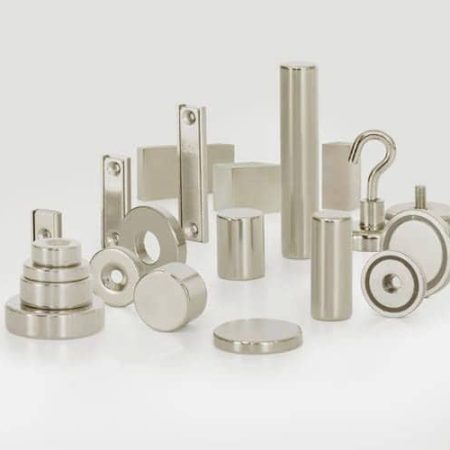
Neodymium (Rare Earth)
329 products -
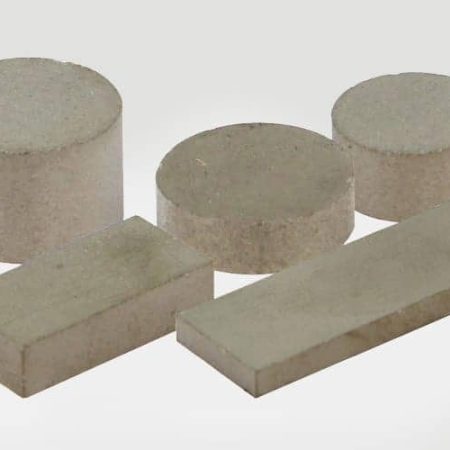
Samarium
15 products -
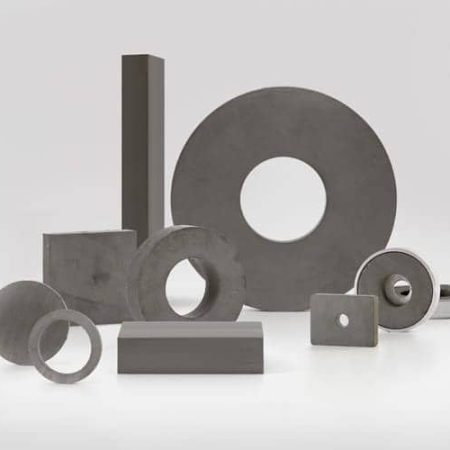
Ceramic (Ferrite)
149 products -
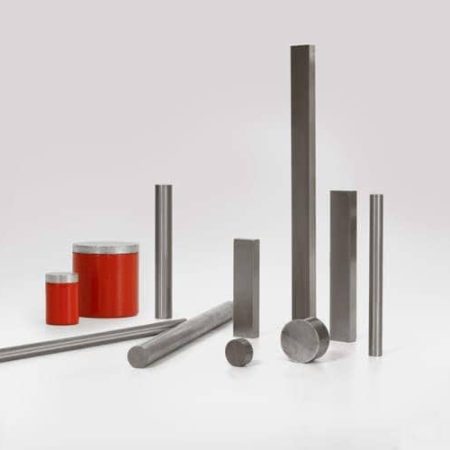
Alnico
16 products -
Magnetic Sheeting
70 products -

Magnetic Strip
47 products -

Magnetic Tools and Equipment
135 products -
Magnetic Separation
75 products -

Printed Magnets
30 products -
Whiteboards & Accessories
68 products